
Landscaper
Walkway landscaping in Boise, Idaho
Walkway landscaping in Boise, Idaho, that sets the route, edges, plants and lighting around your path. Call (541) 961-7269 to schedule a consultation and walk the yard with me.
Walkway landscaping in Boise, Idaho, that sets the route, edges, plants and lighting around your path. Call (541) 961-7269 to schedule a consultation and walk the yard with me.
Walkway landscaping in Boise is about more than the path itself. It's how the path feels to walk, what grows beside it, where the water goes, and whether you can find your way after dark. A lot of homeowners tell me some version of the same thing: "Everyone cuts across the lawn," or "The walk to our front door feels like an afterthought."
I'm Kabe Hockema. I design and build walkways as part of the landscaper work I do. If you mainly need the paving, that's covered on my driveway or walkway paving page. This page is about the whole route: layout, edges, plants, lighting, and the details that make a path work all year.
Signs your walkway needs work
- There's a worn line in the grass where people actually walk.
- The path is too narrow for two people, a stroller, or the trash cans.
- Plants have grown over the edges, or the edges are bare dirt and weeds.
- Sprinklers spray the walk every morning, and it ices over in winter.
- Guests can't tell which door is the front door.
- It's hard to see the path at night.
Where the path should go
People take the shortest route. If a walkway makes them go the long way, they'll make their own path through the lawn. Landscapers call that a desire line. So I start by looking at how you use the yard: where you park, which door you use, where the gate is, where the kids head when they get home. Then I lay out a route that follows that.
Curves look nice, but only when there's a reason for them, like going around a tree or a planting bed. A curve with no reason gets cut across. A fairly direct line to the front door makes the entry clear to visitors.
Width, edges and surface
For one person, a garden path can be about 3 feet wide. A main walk to the front door should be closer to 4 or 5 feet so two people can walk side by side. A wider walk also leaves room to push snow to the side.
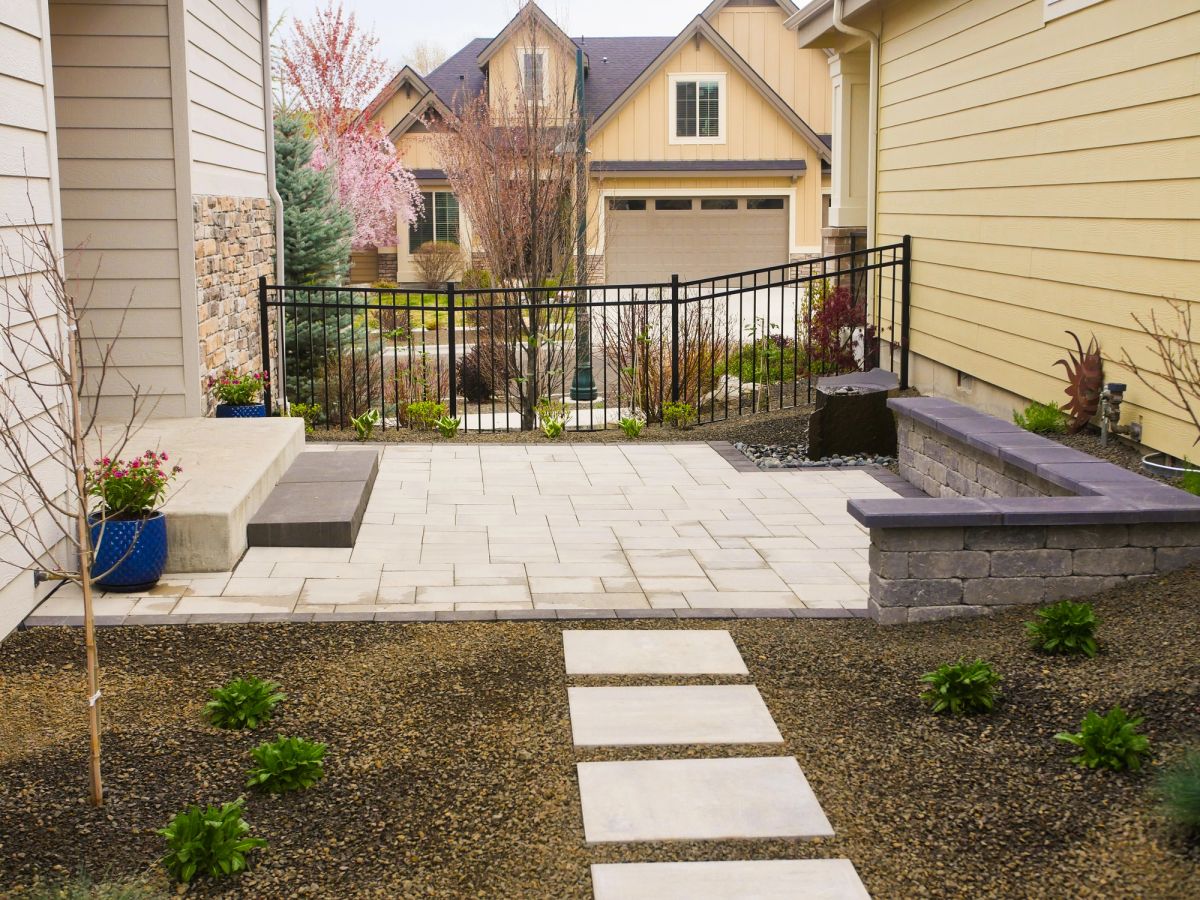
Edges matter more than people expect. A clean edge, whether it's steel edging, a row of pavers set on end, or a line of stone, keeps gravel in, keeps grass out, and keeps the line crisp. The surface depends on how the path is used. Pavers and flagstone suit main walks. Gravel or decomposed granite works for side paths. Decomposed granite is crushed rock fine enough to pack down firm. Stepping stones set in low groundcover give a garden feel. For side yard paths with rock and boulders, see rock landscaping.
Planting along a walkway
Plants next to a path should stay low and stay put. I skip anything thorny, plants that drop berries on the walk, and shrubs that will be in the path in three years. Low grasses, creeping groundcovers, and perennials with a known mature size work well right at the edge. Taller plants go a few feet back so the walk doesn't feel pinched. Ice melt can burn plants along a front walk, so there I pick tougher plants or leave a narrow gravel strip.
Water, light and winter
Spray sprinklers next to a walk waste water and leave white stains on pavers. In winter, any water left on the path freezes. I move spray heads back or switch the beds along the walk to drip irrigation, which waters at the roots and keeps the path dry. I also pitch the walk slightly so it sheds water, and I make sure downspouts don't empty across it.
Lighting makes a walkway usable after dark. Low path lights along the edge, or lights in a nearby tree pointed down, show the way without glare. My landscape lighting page has more on that.
What changes the price of a walkway
The length and width of the walk, the surface material, and how much planting goes along it set most of the cost. Removing an old concrete walk, fixing grade, adding outdoor steps where the path climbs, moving sprinkler lines, and adding lights each add to it. If the walk ties into a driveway, driveway landscaping may make sense at the same time. I'll price it all out after the consultation so you know what each part costs.
Walkway landscaping around the Treasure Valley
I design and build walkways in Boise, Garden City, Eagle, Meridian, Star, Kuna, Nampa, Caldwell, Middleton and Hidden Springs, and on select projects in Sun Valley and Ketchum. Older homes in the North End and on the Boise Bench often have narrow, cracked front walks that are ready for a redo. New builds tend to have a plain strip of concrete and nothing around it.
If you're ready for walkway landscaping in Boise that people actually use, schedule a consultation or call me at (541) 961-7269.
More landscaper services
- Artificial turf installation
- Concrete masonry
- Desert landscaping
- Driveway landscaping
- Driveway or walkway paving
- Garden decorating
- Garden design
- Grading & resloping
- Grass seeding
- Green landscaping
- Hardscaping
- Hydroseeding
- Landscape installations
- Landscape management
- Lawn landscaping
- Outdoor step construction
- Outdoor water feature design
- Pool landscaping
- Retaining walls
- Rock landscaping
- Sod installation
- Stone landscaping
- Stone masonry
- Tree landscaping
- Yard drainage
- Yard grading
- Yard landscaping
Walkway landscaping is part of my landscaper services in Boise and is also listed under landscape designer.
Walkway landscaping questions
Paving is the path surface itself: pavers, flagstone, concrete or gravel. Walkway landscaping is everything around it, like the route, edges, plants, irrigation and lighting. Many projects need both, and I plan them together.
For a main front walk, pavers and flagstone hold up well to freeze-thaw and are easy to shovel. Gravel and decomposed granite cost less and suit side paths and garden walks. The best choice depends on how much traffic the path gets and the style of the house.
Start with a compacted base and a layer of landscape fabric under the gravel, then hold it all in with solid edging. Keep the gravel deep enough that seeds blowing in can't reach soil. A quick pull in spring takes care of the rest.
Often, yes. If the path is level and in good shape, the beds, edges, irrigation and lighting can be redone around it. If the walk is cracked or heaved, it's usually better to fix it at the same time.

Let's chat
Let's talk about your vision
If you're ready to create a space that's personal, timeless, and built to last, I'd love to hear what you're imagining. Let's start with a low-pressure conversation and see if we'd be a good fit to work together.
Schedule a Consultation