
Hardscapes
Paver patios built to stay flat
Concrete paver and natural stone patios for Boise, Eagle, Meridian and the Treasure Valley, built on a base designed for our soil and our winters.
Concrete paver and natural stone patios for Boise, Eagle, Meridian and the Treasure Valley, built on a base designed for our soil and our winters.
A patio is only as good as what's under it
How I build paver patios that survive Treasure Valley clay and freeze-thaw winters, what the materials cost, and what to ask when you compare bids.
Most patios in the Treasure Valley don't fail because of the pavers. They fail because of what's underneath. A lot of the valley sits on clay and silt that hold water, and our winters swing above and below freezing again and again. Water that gets under a patio freezes, expands and lifts it. Repeat that for a few seasons on a thin base and you get the heaved edges, sunken corners and weedy joints you see all over town. Paver patios are the most common project in my hardscape work, and nearly everything that makes one last is decided before the first paver goes down.
How I build a paver patio
Excavation and soil
I dig out the topsoil and anything organic, then look at what's left. On stable, well-drained ground the base can go straight onto compacted subgrade. On the heavy clay common across much of the valley, I lay a geotextile fabric first so the gravel base doesn't slowly push down into the clay over the years. If water already collects where the patio is going, I solve that now, with grading or a drain, rather than building on top of the problem.
The base
The base is crushed gravel, compacted in thin lifts rather than dumped and run over once. On stable soil a patio typically gets 4 to 6 inches of compacted base. On clay, on poorly drained ground, or anywhere a vehicle might park, it goes deeper. This is the step where cheap patios save money, and it's the step that decides whether your patio is still flat in ten years.
Bedding and slope
Pavers sit on a thin, screeded layer of coarse bedding sand, about an inch, not a thick bed that shifts underfoot. The finished surface is pitched slightly away from the house, roughly a quarter inch per foot, so water runs off instead of sitting against your foundation or soaking into the joints.
Edges and joints
An edge restraint around the perimeter keeps the field from creeping outward. The joints are filled with polymeric sand, which hardens once it's wetted and resists weeds, ants and washout far better than plain sand. Then the whole patio is compacted again so every paver locks against its neighbors. That interlock is what lets a paver patio flex through an Idaho winter without cracking the way a slab does.
Nearly everything that makes a patio last is decided before the first paver goes down.
Concrete pavers, natural stone or permeable
Concrete pavers
Concrete pavers are the workhorse of Boise patios: consistent, strong, and available in a huge range of sizes, colors and textures. For freeze-thaw country, look for pavers made to ASTM C936, the industry standard for interlocking concrete pavers, which major lines such as Belgard and Techo-Bloc publish for their products. Large-format slabs read clean and modern; tumbled pavers read older and more relaxed.
Natural stone
Flagstone, bluestone, travertine and granite bring a character manufactured pavers don't copy. Stone takes more care to set because thickness varies from piece to piece, and some stone absorbs more water than others, which matters when it freezes. Our guide to hardscape materials for Idaho's freeze-thaw climate goes deeper on which stones hold up here.
Permeable pavers
Permeable systems use wider joints filled with small stone so water drains through the surface into an open-graded base. They make sense where drainage is a problem or where you want to keep runoff on your own lot. They cost more, mostly because the base is deeper.
What a paver patio costs in Boise
I can't price your patio without seeing the site, but these are the typical installed ranges from our Boise patio cost guide. They assume a proper base, which is where most of the difference between bids hides.
- Mid-grade concrete pavers: about $8 to $15 per square foot installed
- Premium concrete pavers: about $15 to $22 per square foot installed
- Natural stone: about $18 to $30 or more per square foot installed
- Steps: about $500 to $2,000 per step, depending on material
A simple 300 to 400 square foot paver patio commonly lands between $12,000 and $20,000. Add a low wall, steps or a more complex layout and $20,000 to $35,000 is more typical. Poor soil, tight access and heavy grading push numbers up. When you compare bids, ask every contractor how deep the base is and how it gets compacted. If two prices are far apart, the answer is usually there.
A patio is usually the floor of something bigger
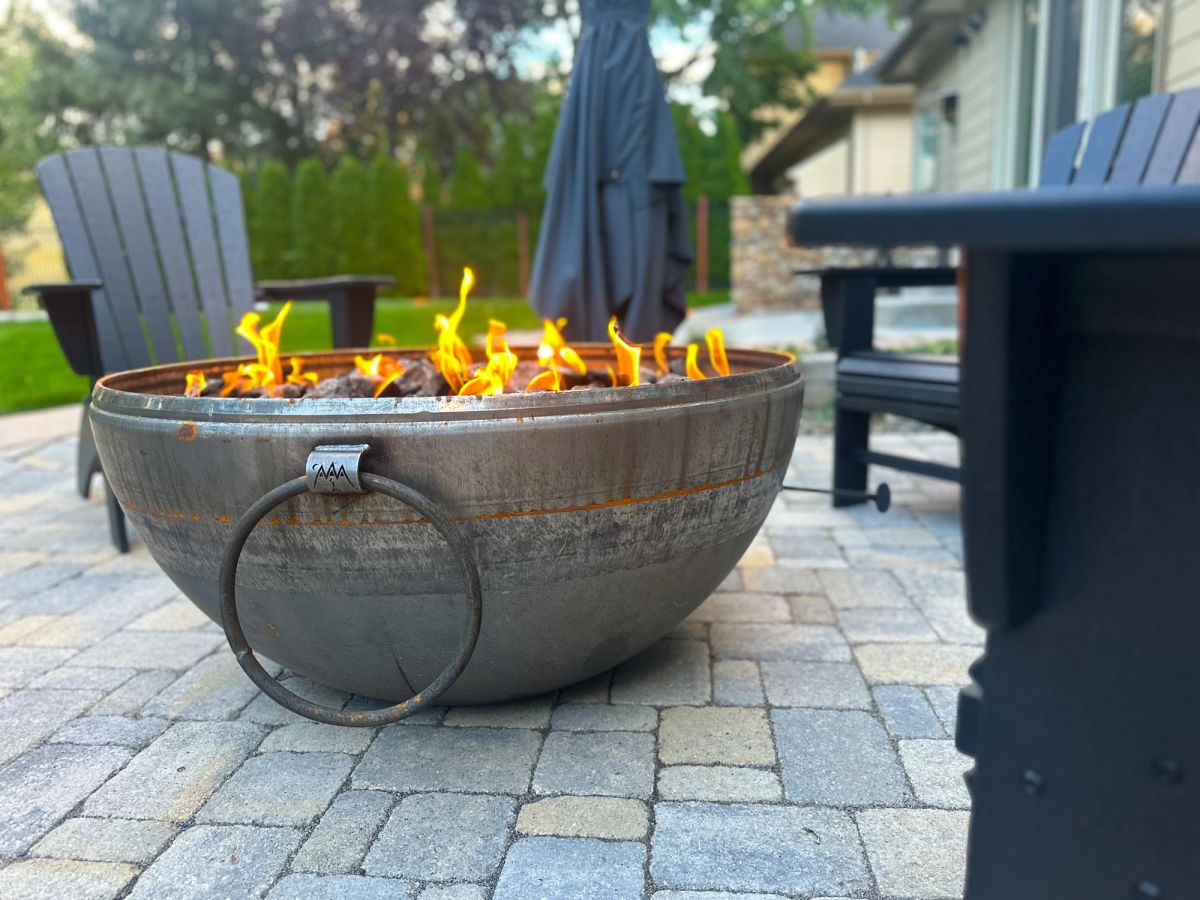
On a sloped lot, a patio often needs a retaining wall or seat wall to create a level pad. It's the natural home for a fire pit or fire bowl, an outdoor kitchen, and landscape lighting that lets you use it after dark. I plan those pieces together, because the gas line, conduit and drainage all need to go in before the pavers do. If you're thinking about the whole backyard, start with outdoor living.
You can see one finished example in our Boise patio reconstruction, which rebuilt an existing patio around a fire bowl seating area.
Why pavers hold up better than poured concrete
Poured concrete is one slab, and in a climate with dozens of freeze-thaw cycles every winter, a slab that can't move eventually cracks. Control joints decide where the cracks go, but they don't stop them. Concrete pavers handle the same weather differently. Each paver is a separate unit locked to its neighbors by sand-filled joints, so the surface can flex slightly as the ground freezes and thaws without breaking.
That flexibility is the main reason pavers last longer here. Manufactured pavers are also denser and stronger than most site-poured concrete, and pavers that meet ASTM C936 are made to resist freeze-thaw damage and the deicing salt that gets tracked in from the driveway. When something does go wrong, like a tree root lifting a corner or a utility line that needs repair, the pavers in that area come up, the base gets fixed, and the same pavers go back down. A cracked slab can only be patched or torn out.
Concrete costs less up front, and for a utility pad behind the garage it can be the right call. For a patio you'll look at and use every day, the durability and repairability of pavers usually make them the better long-term investment.
Patterns, shapes and colors
One reason homeowners choose pavers is the variety. The same patio can look modern, traditional or rustic depending on the paver shapes, the laying pattern and the color blend, and the selection from manufacturers keeps growing. I bring samples to the design meeting so you can see them next to your house in your own light, which tells you more than any catalog photo.
Laying patterns
- Herringbone: pavers set at 45 or 90 degrees in a zigzag. It's the strongest interlocking pattern, which is why it's the standard for driveways and anywhere with vehicle traffic.
- Running bond: rows offset like brick. Clean and simple, and it can make a narrow patio or walkway feel longer when the rows run with the space.
- Basketweave: pairs of pavers alternating direction. A traditional look that suits older homes and cottage-style gardens.
- Random or ashlar: several paver sizes mixed in a repeating module. It reads like cut stone and hides minor color variation well.
Borders and accents
A border course, usually a row of pavers along the edge in a contrasting color or direction, frames the field and gives the edge restraint a clean line to hold. Borders, inlays and banding are also an easy way to divide a large patio into zones, like a dining area and a fire pit area, without adding walls.
Choosing a color
Color is about more than style. Blends with two or three tones hide dust, leaves and small stains far better than a single flat color. Dark pavers get hot in a Boise July and show dust. Very light pavers show tire marks and spills. Most clients land on a mid-tone blend that picks up a color from the house, the roof or the stone on the front of the home, so the patio looks like it was always part of the property instead of added later.
Natural stone: flagstone, sandstone and granite
Concrete pavers are consistent. Natural stone is the opposite, and that's its charm. Flagstone is the classic choice for an informal patio or garden path, with irregular edges that fit together like a puzzle. Sandstone has warm tones and a natural texture underfoot, but it's softer and more porous, so choosing a dense stone rated for freeze-thaw matters. Granite is about as durable as stone gets and handles heavy traffic and winter well. Travertine and bluestone are more refined options for formal spaces and pool decks.
Stone takes more labor than pavers because every piece is cut and fit by hand, which is part of why it sits at the upper end of the price ranges above. It goes down on the same compacted base. Dry-laid stone sits on a sand or fine gravel bed with sand or stone dust in the joints. Mortared stone sits on a concrete slab, which makes it true masonry work, and the slab needs the same attention to base and drainage so the mortar doesn't crack in the first winter. Our guide to hardscape materials for Idaho's freeze-thaw climate compares the options in more detail.
Pavers for pool decks
Pool decks are one of the best uses for pavers. They handle splash and pool chemicals, they stay slip resistant when wet if you choose a textured finish, and lighter colors stay cooler under bare feet. A pool deck also needs careful grading so water drains away from both the pool and the house, and the joints have to tolerate constant wetting. Our poolside backyard renovation in Eagle is one example of paver patios built around a new pool.
Walkways, steps and driveways
The same rules apply to every paved surface, but the load changes the build. A walkway carries foot traffic and gets the same base as a patio, with enough width for two people to walk side by side. Steps need consistent risers and a solid footing so they don't settle unevenly and become a trip hazard.
Driveways and parking pads are a different engineering problem. Vehicles put far more weight on a small area, and turning tires twist the surface. A paver driveway needs a deeper base, thicker pavers (usually 80 mm instead of the 60 mm common on patios) and an interlocking pattern like herringbone that resists shifting. If you're building a patio now and might pave the driveway later, it's worth choosing the paver line together so the colors match.
Grading: where the water goes
Every patio has to send water somewhere. Before any base goes in, I check the grading around the house so the finished surface falls away from the foundation at about 1/4 inch per foot. Downspouts that would dump onto the new patio get piped or redirected. On flat lots, I look at where the water ends up past the patio edge so it doesn't just move the puddle into the lawn. Poor grading is the quiet cause of many failed patios: water sits in the base, freezes, and lifts the pavers.
Maintenance, sealing and weeds
A well-built paver patio is low maintenance, but not no maintenance. Here's what it actually takes:
- Sweep and rinse as needed. Leaves and dirt left sitting in the joints are what feed weeds.
- Check the joints each spring. Polymeric sand hardens to resist washout, but after a few seasons some joints may need a top-up, especially near downspouts and edges.
- Pull weeds while they're small. Weeds in paver joints almost always come from seeds that blow in and sprout in debris on top, not from below, because a compacted base doesn't give them a path up.
- Clean stains promptly. Grill grease and rust from metal furniture lift much more easily when they're fresh.
Sealing is optional. A sealer can deepen color, make stains easier to clean and help lock the joint sand in place, but it has to be reapplied every few years and some sealers change the look of the surface. Plenty of homeowners skip it and are happy. If you do want a sealed surface, wait until the pavers have weathered for a season so any efflorescence, the white haze that sometimes shows up on new concrete pavers, has worked its way out first.
From estimate to finished patio
Every project starts with a site visit. I look at the soil, slope, access, drainage and how you plan to use the space, then put together a design and an estimate. For projects where it helps, that includes detailed plans and 3D renderings so you can see the layout before work begins. Once the design is approved, paver installation follows the steps above: layout, excavation, base, bedding, pavers, joints and cleanup, with a final walkthrough at the end.
If you're comparing contractors, ask each one how deep they excavate, how thick the base is, how they compact it and what edge restraint they use. Those answers tell you more about how the patio will look in ten years than the price does. Reviews and testimonials from past clients help too, especially comments about how a patio held up after a few winters, not just how it looked on day one. Our article on what to ask a landscaper before hiring has a longer list, and you can see finished work in the portfolio.
Who builds it
I design and build every patio myself with a small crew, so the person who plans your base is the person who checks it. Hockema Landscape Design & Build is an Idaho licensed contractor (license 6871843), bonded and insured, with 15 years of landscape construction behind the work.
Paver patio questions
Built on a proper base with good drainage, a concrete paver patio lasts for decades, and individual pavers can be lifted and reset if a section settles or a utility needs to be reached. Most early failures trace back to a thin base or water getting under the patio, not the pavers themselves.
Poured concrete costs less upfront, about $8 to $12 per square foot for a basic broom-finish slab, but slabs crack with freeze-thaw movement and repairs show. Pavers flex with the ground through Idaho winters, and damaged pieces can be replaced one at a time. For a patio you plan to keep, pavers are usually the better long-term value.
Most ground-level patios don't need a building permit. Adding a roof structure, gas, electrical or plumbing usually does, and I coordinate those permits when the project calls for them.
Most residential patios take 2 to 4 weeks of active work, plus lead time for materials. Projects that include walls, kitchens or significant grading run longer, and I'll give you a schedule before we start.
Yes, with some care. Use a plastic shovel blade or a snow blower set slightly high, and pick a deicer labeled safe for concrete pavers. Avoid rock salt and anything containing ammonium compounds, which attack concrete. Clearing snow promptly also limits how much meltwater soaks into the joints.
Often, yes. Pavers can be lifted, the base corrected and the same pavers relaid. Whether that's the right call depends on the condition of the pavers and why the patio failed, and I'll tell you honestly once I've seen it.
Individual pavers rarely crack. What goes wrong on a poorly built patio is movement: settling, heaving or shifting, caused by a thin base, poor compaction or water sitting under the surface. A patio built on a properly excavated, compacted base with good drainage handles Treasure Valley freeze-thaw cycles well, and a damaged paver can be pulled and replaced on its own.
It's optional. Sealing can enrich the color and make cleanup easier, but it adds a maintenance task every few years and can change the look of the surface. If you decide to seal, wait about a season after installation so any efflorescence on new concrete pavers has a chance to clear first.
Keep the joints full and the surface clean. Most weeds sprout from seeds that land in dirt and debris on top of the joints, so regular sweeping does most of the work. Polymeric sand resists weed growth better than plain sand, and topping up any low joints each spring keeps it effective.
Yes, but a driveway is built differently from a patio. It needs a deeper compacted base, thicker pavers rated for vehicles and an interlocking pattern such as herringbone so turning tires don't shift the surface.
Herringbone is the strongest and the right choice anywhere cars will drive. For patios, it comes down to style: running bond is clean and modern, basketweave is traditional, and random or ashlar patterns look like cut stone. I'll lay out a couple of options against your house during design.
For most homeowners, yes. A well-built paver patio adds usable living space, it lasts for decades when the base is right, and repairs are simple because individual pavers can be lifted and reset. It costs more than poured concrete up front, but it avoids the cracking that eventually forces a slab to be replaced.
Portfolio
Recent Projects
Patios and outdoor spaces we've built across the Treasure Valley.


Let's chat
Planning a patio?
Tell me about the space, how you want to use it, and your budget. I'll walk the site with you and give you an honest picture of what it will take to build it right.
Schedule a Consultation