C
Catherine Dollahite
West Eagle, Idaho
"Our Dream Backyard Made Easy! We love our backyard. Highly recommend! Thanks Kabe Hockema!"

Outdoor Living
Low-voltage LED landscape lighting for paths, trees, patios and water features across Boise and the Treasure Valley.
Low-voltage LED landscape lighting for paths, trees, patios and water features across Boise and the Treasure Valley.
What to light, how to avoid glare, how a low-voltage system is built, and why it belongs in the plan before the patio goes in.
In an Idaho summer, the best hours to be outside come after sunset. Lighting is what makes those hours usable: steps you can see, a patio you can stay on, and trees and walls that still look good at night. Done well, you notice the landscape, not the lights. I design lighting as part of the whole outdoor living space, so the wire and fixtures go in while the ground is open, not bolted on afterward.
The most common lighting mistake is too much of it: every shrub lit, fixtures pointed at eyes and windows, and a yard that glows like a car lot. I light in layers and leave some dark between them, because contrast is what makes a lit tree look dramatic. You should see the effect, not the bulb. That means shielded fixtures, careful aiming away from neighbors and the street, and warm white light, typically 2700K to 3000K, that flatters plants, stone and skin. Cooler light reads harsh and clinical outdoors.
You should see the effect, not the bulb.
I install 12-volt LED systems. Low voltage is safer to run through planting beds, easy to adjust as plants grow, and LED uses a fraction of the power older halogen systems did. A transformer plugs into an outdoor GFCI outlet and steps the power down for the fixtures.
Voltage drops over long wire runs, which is why cheap systems have bright fixtures near the transformer and dim ones at the end. I size the wire to the load and lay it out in hubs, so each group of fixtures gets the same voltage. Cable is buried below the beds and lawn, and anywhere it crosses under hardscape, it runs in conduit.
Boise's sun, freeze-thaw and sprinkler water are hard on fixtures. I prefer solid brass and copper, which weather to a natural patina and hold up for years, over the painted aluminum and plastic fixtures that fade, corrode and crack.
An astronomical timer turns the lights on at dusk and adjusts through the year as the days change, so you never reset it. Many systems can also be split into zones and controlled from your phone, so the patio can stay on after the front yard goes dark.
The cheapest time to add lighting is before the patio is laid and the walls are built. Conduit sleeves under the pavers and wire run inside walls for step and cap lights take an hour during construction and a day of demolition later. If you're adding a fire feature or an outdoor kitchen, the lighting and electrical get planned together in the same trenches. Existing landscapes can still be lit; crossing under finished patios and walks just takes more work.
Good landscape lighting is a combination of a few techniques, each used where it fits:
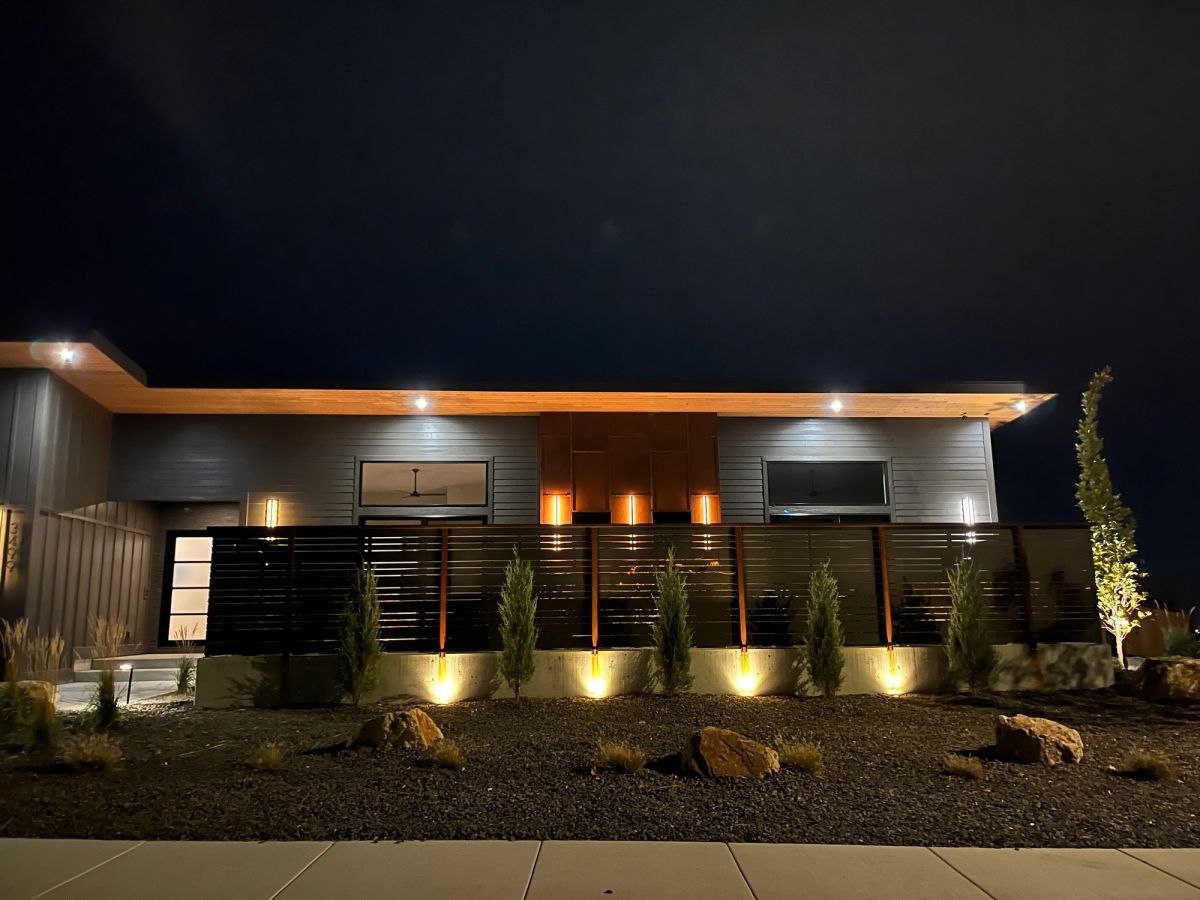
A fixture at the base of a tree, column or wall aimed up. It's the most dramatic effect and the one that makes a property feel finished from the street. Tall trees take a narrow beam to reach the canopy, while broad, low trees look better with a wider spread or two fixtures.
Fixtures mounted high in a mature tree or under eaves and pergolas shine down. Mounted in a tree, the light filters through the branches and casts soft, moving shadows on the patio or lawn below, like moonlight. It's the most natural-looking technique and great over dining and seating areas.
Low fixtures that spread light across a walkway or planting bed. Staggered along a path rather than lined up like a runway, they guide people without looking like an airport.
Light placed close to a textured stone wall or chimney grazes across it and brings out every edge. Set farther back, a wider beam washes a smooth surface evenly. Lighting the wall behind a sculptural plant turns the plant into a silhouette.
Low-profile fixtures tucked under the cap of a seat wall or retaining wall, or recessed into a step riser, light the ground without showing the source. They're the cleanest way to make grade changes safe at night.
The front of the house is where lighting does the most for curb appeal. A few uplights on the facade and front trees, soft light on the entry walk and steps, and a light on the address number make a home look welcoming and easy to find. I keep front yard lighting balanced so the house doesn't look like a stage set, with the brightest light at the front door and less everywhere else.
Most landscape lighting starts with safety: steps, grade changes, the walk from the driveway and the path to the side gate. Steady, even light also helps security. It removes dark corners where someone could stand unseen and makes the property look lived in. Glare works against both. A bright, unshielded fixture blinds you to everything behind it, which is why I use shielded fixtures aimed away from where people look.
A low-voltage system runs from a transformer that steps household current down to 12 volts. I size the transformer for the full fixture load with headroom left over, so adding a few lights later doesn't mean replacing it. Splitting the system into zones lets the front yard, back yard and patio run on different schedules, and a patio zone can be switched or dimmed separately for evenings outside.
Wire runs are planned so fixtures at the far end of a run get the same voltage as the ones near the transformer. Connections are made with waterproof connectors and buried at a proper depth, with spare wire left at each fixture so it can be moved as plants grow.
Two settings decide how each fixture looks: how wide the light spreads and how bright it is. Narrow beams reach up tall trunks and columns. Wide beams wash walls and broad shrubs. Most residential landscape lights need far less brightness than people expect, because the eye adjusts to darkness and a little light goes a long way at night. Keeping the color warm, in the 2700K to 3000K range, makes plants, stone and wood look natural.
A lighting design should look good in January, not just June. Deciduous trees look completely different once the leaves drop, and uplit branches against a winter sky can be the best view in the yard. Evergreens and ornamental grasses carry the design through winter, and snow reflects light, so a system that looks right in summer can feel brighter in December. The astronomical timer handles the changing sunset times on its own, including the jump at daylight saving.
Light that spills into a neighbor's bedroom window or shines straight up into the sky is wasted light. I aim fixtures at what they're meant to light, use shields and glare guards, and keep brightness modest. On foothill and rural properties, where night skies are darker, that restraint matters even more.
LED systems need very little maintenance. Once a year, it's worth wiping dirt and hard water spots off the lenses, trimming plants that have grown over fixtures and adjusting the aim on lights that have been bumped by a mower or a dog. As trees mature, uplights may need to move back or switch to a wider beam. Lighting works best as part of a complete outdoor living plan, where the patio, kitchen, fire feature and planting are designed with the lighting from the start.
If you want music outside, the same trenches can carry speaker wire. Several small landscape speakers spread around the patio at low volume sound better, and bother the neighbors less, than one pair turned up loud. Like the lighting, it's far easier to plan in than to add later.
Hockema Landscape Design & Build is an Idaho licensed contractor (license 6871843), bonded and insured, with 15 years of experience building landscapes across the Treasure Valley.
Low-voltage LED landscape lighting generally doesn't require a permit in Boise. New standard-voltage outlets and hardwired lighting do, and that work is done by a licensed electrician.
For landscape lighting, low voltage almost every time. It's safer around planting beds and irrigation, easy to adjust as the landscape grows, and very efficient with LED. Line voltage is mainly for fixtures mounted on the house, installed by an electrician.
Yes. Wire can be run through existing beds and lawn with little disruption. Getting under finished patios and walkways takes more work, which is why I plan lighting into new hardscape from the start.
Warm white, typically 2700K to 3000K. It makes plants, stone and wood look natural and feels inviting. Cooler, bluer light tends to look harsh in a landscape.
Quality LED lamps are typically rated for tens of thousands of hours, which works out to many years of nightly use. In practice, the fixture body and wire connections decide how long a system lasts, which is why I use solid brass and copper fixtures and waterproof connections.
Not by much. Low-voltage LED fixtures use a small fraction of the power of the old halogen systems, and an astronomical timer keeps them on only when they're needed.
Yes. Many transformers can be paired with smart controls that let you set schedules, switch zones and dim lights from an app. An astronomical timer alone covers most needs, and app control is a good add-on if you want a patio zone you can turn up for guests.
Fewer than most people think. The count depends on what you want to light, not the square footage. A front yard might need a handful of uplights, some path lights and a few on the entry, while a large back yard with a patio, steps and trees needs more. I design the layout first and count fixtures from there.
“I can't say enough to do justice for my new zen garden! Thank you, Kabe and Hockema Landscape Design & Build team”
"Our Dream Backyard Made Easy! We love our backyard. Highly recommend! Thanks Kabe Hockema!"
"Five Stars – Exceptional Landscape Vision & Execution! My wife and I recently completed a major backyard transformation. If you are considering a new landscape or a complete redesign, I cannot recommend a more talented and professional team than Brian Bentler (Boise Landscape Design) and Kabe Hockema (Hockema Landscape Design & Build). Their combined expertise delivers nothing short of a five-star result!"
"I've had the pleasure of working with Kabe on a pool project in Eagle and he did a fantastic job! From start to finish everyone was in sync and very pleased with the finished product. I highly recommend him for all your backyard dreams!"
Portfolio
Outdoor spaces we've designed and built across the Treasure Valley.

Let's chat
Tell me how you use the space at night and what you'd like to see. I'll walk the property with you and show you where light will do the most.
Schedule a Consultation

