Sustainable Landscaping
Mulch and Ground Cover for Boise Yards: Less Water, Better Results
In Boise's dry climate, mulch is one of the most impactful things you can apply to a planted area. And the choice between organic mulch, rock mulch, and living ground covers shapes how a landscape looks, performs, and how much water it needs year after year.
In Boise's dry climate, mulch is one of the most impactful things you can apply to a planted area. And the choice between organic mulch, rock mulch, and living ground covers shapes how a landscape looks, performs, and how much water it needs year after year.
Why Mulch Matters in Boise
Bare soil in Boise's summer sun is a problem. Surface evaporation from exposed soil dramatically increases irrigation demands. Bare soil compacts under irrigation and foot traffic, reducing infiltration and root health. Weeds establish quickly in bare ground, competing with planted material for water and nutrients. Mulch addresses all three problems.
Organic Mulch: Wood Chips and Bark
Wood chip mulch is my default recommendation for planting beds in Boise landscapes. Applied at 2 to 3 inches, it conserves soil moisture, moderates soil temperature, suppresses weed germination, and feeds soil biology as it breaks down over time. In alkaline Treasure Valley soils, decomposing organic mulch has a modest acidifying effect, a genuine benefit for most landscape plantings.
Refresh organic mulch annually: apply a fresh layer over the existing decomposed material each spring to maintain the 2 to 3 inch depth.
Rock Mulch and Decomposed Granite
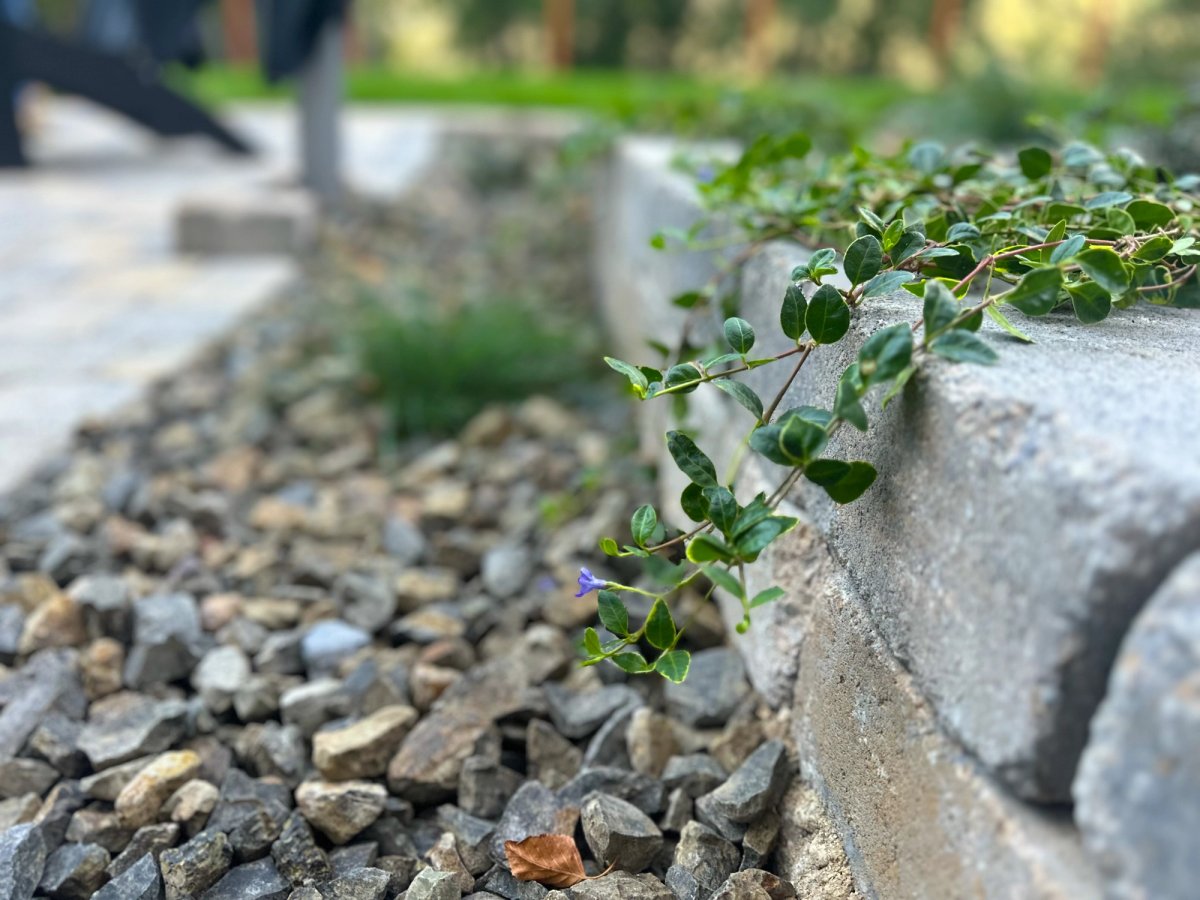
Rock mulch and decomposed granite (DG) are common in Treasure Valley landscapes and have legitimate applications. They don't decompose and need minimal replacement. For pathways, dry streambeds, and areas where a clean inorganic look fits the design, DG and rock perform well.
The limitations: rock mulch absorbs heat in Boise's summer sun, raising soil temperatures and increasing water stress on nearby plants. It provides no soil-building benefit over time. I use rock and DG selectively, in areas where the design calls for it and where heat absorption won't stress adjacent planting.
Rock mulch absorbs heat in Boise's summer sun, raising soil temperatures and increasing water stress on nearby plants. Choose plants accordingly.
Living Ground Covers
Kinnikinnick (Arctostaphylos uva-ursi)
Native, evergreen, and extremely drought-tolerant once established. Grows 6 to 8 inches tall, spreads slowly across slopes and dry areas. Pink flowers in spring, red berries in fall. Excellent for slopes where erosion control and low water use are priorities.
Creeping Thyme (Thymus serpyllum)
Low-growing, fragrant, drought-tolerant once established. Works between stepping stones and as a lawn alternative in small areas. Handles foot traffic reasonably well and blooms in pink to purple in early summer.
Idaho Fescue (Festuca idahoensis)
Native bunchgrass that functions as a ground cover in full sun with good drainage. Not for traffic areas, but excellent for slopes, decorative areas, and naturalized settings with a minimal-water approach.
Ground covers and mulch choices are most effective when they're part of a broader sustainable planting strategy. Our sustainable landscaping guide for Boise homeowners puts mulch, ground covers, and water conservation into the full context of a low-input landscape.
Frequently Asked Questions
How much mulch should I apply and how often?
Apply 2 to 3 inches of wood chip mulch initially, keeping it a few inches away from plant stems and tree trunks. Refresh annually each spring: a half-inch to inch of new mulch over the previous year's decomposed layer maintains the functional depth without over-mulching.
Will rock mulch hurt my plants?
Rock mulch in full Boise sun can significantly raise soil temperature, which stresses many plants. Plants with high heat tolerance, including cacti, agave, rabbitbrush, and Russian sage, handle it better than moisture-loving plants.
Written by
Kabe Hockema
Owner and principal designer at Hockema Landscape Design & Build. Twenty years of experience designing and building custom landscapes across Boise, Eagle, Meridian, Sun Valley, and the broader Treasure Valley.
Keep reading
Related Articles


Let's chat
Let's talk about your vision
If you're ready to create a space that's personal, timeless, and built to last, I'd love to hear what you're imagining. Let's start with a low-pressure conversation and see if we'd be a good fit to work together.
Schedule a Consultation