Sustainable Landscaping
Eco-Friendly Landscaping in the Treasure Valley: What Actually Works
Eco-friendly landscaping covers a lot of territory, and not all of it is equally practical or impactful in the Treasure Valley. Here's a direct look at what actually produces meaningful environmental benefit in Boise's specific conditions.
Eco-friendly landscaping covers a lot of territory, and not all of it is equally practical or impactful in the Treasure Valley. Here's a direct look at what actually produces meaningful environmental benefit in Boise's specific conditions, and what's more aspiration than practice.
What Actually Works
Native Plants
The single most impactful ecological choice in a Boise landscape. Native plants reduce water use once established, support local pollinators and wildlife in ways exotics don't, require fewer chemical inputs, and are adapted to our soil chemistry without amendment. Our native plants guide covers the best species for the Treasure Valley and how to integrate them into a designed planting.
Efficient Irrigation
Switching to drip irrigation in planted beds, installing a smart controller, and hydrozoning the landscape consistently produce 20 to 40 percent water reductions compared to conventional spray irrigation on fixed schedules. Our guide to cutting water use with efficient irrigation details the specific changes with the highest return.
Organic Mulch
Two to three inches of wood chip mulch on planting beds reduces irrigation frequency, moderates soil temperature, suppresses weeds without herbicide, and feeds soil biology as it breaks down. It's one of the simplest and most impactful sustainable practices in any Boise garden.
Turf Reduction
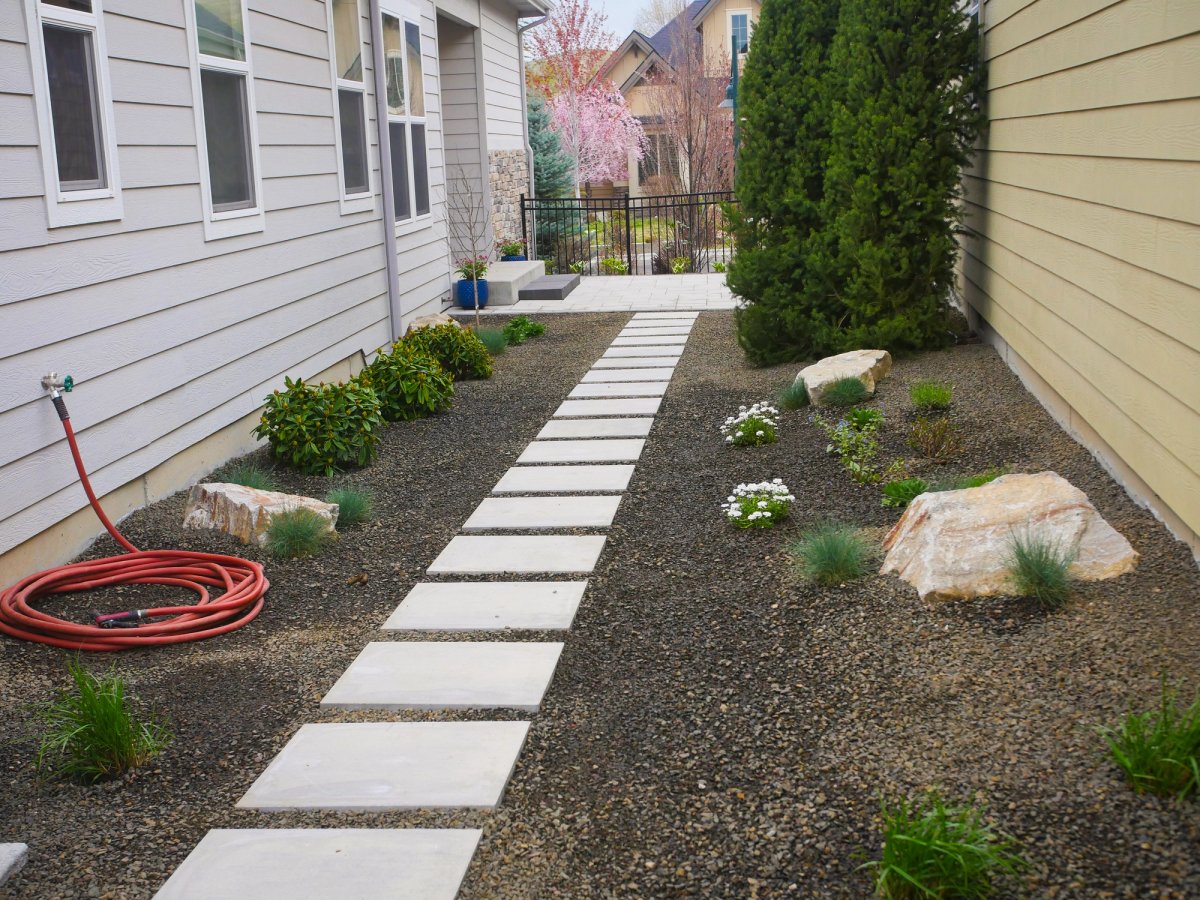
Lawn is the most resource-intensive element in most residential landscapes, requiring high water, regular mowing, fertilizer, and pest management. Reducing total turf area and replacing with drought-tolerant alternatives delivers real environmental benefit.
The single most impactful ecological choice in a Boise landscape is native plants. They reduce water use, support local pollinators, and require fewer chemical inputs.
What's More Complicated in Boise's Context
Rain Gardens
Rain gardens work well in climates with regular precipitation. In Boise, where our annual rainfall averages 12 inches with most of it in spring and winter, rain gardens have limited opportunity to function as designed during the dry summer months. They can be valuable for managing spring runoff, but aren't the year-round stormwater solution they are in wetter climates.
Frequently Asked Questions
Is organic landscaping possible in Boise?
Yes, and it's increasingly common. Organic fertilizers, biological pest controls, and avoiding synthetic herbicides and pesticides are all achievable in Boise landscapes, particularly when plant selection and soil health reduce the need for chemical intervention in the first place.
Written by
Kabe Hockema
Owner and principal designer at Hockema Landscape Design & Build. Twenty years of experience designing and building custom landscapes across Boise, Eagle, Meridian, Sun Valley, and the broader Treasure Valley.
Keep reading
Related Articles


Let's chat
Let's talk about your vision
If you're ready to create a space that's personal, timeless, and built to last, I'd love to hear what you're imagining. Let's start with a low-pressure conversation and see if we'd be a good fit to work together.
Schedule a Consultation